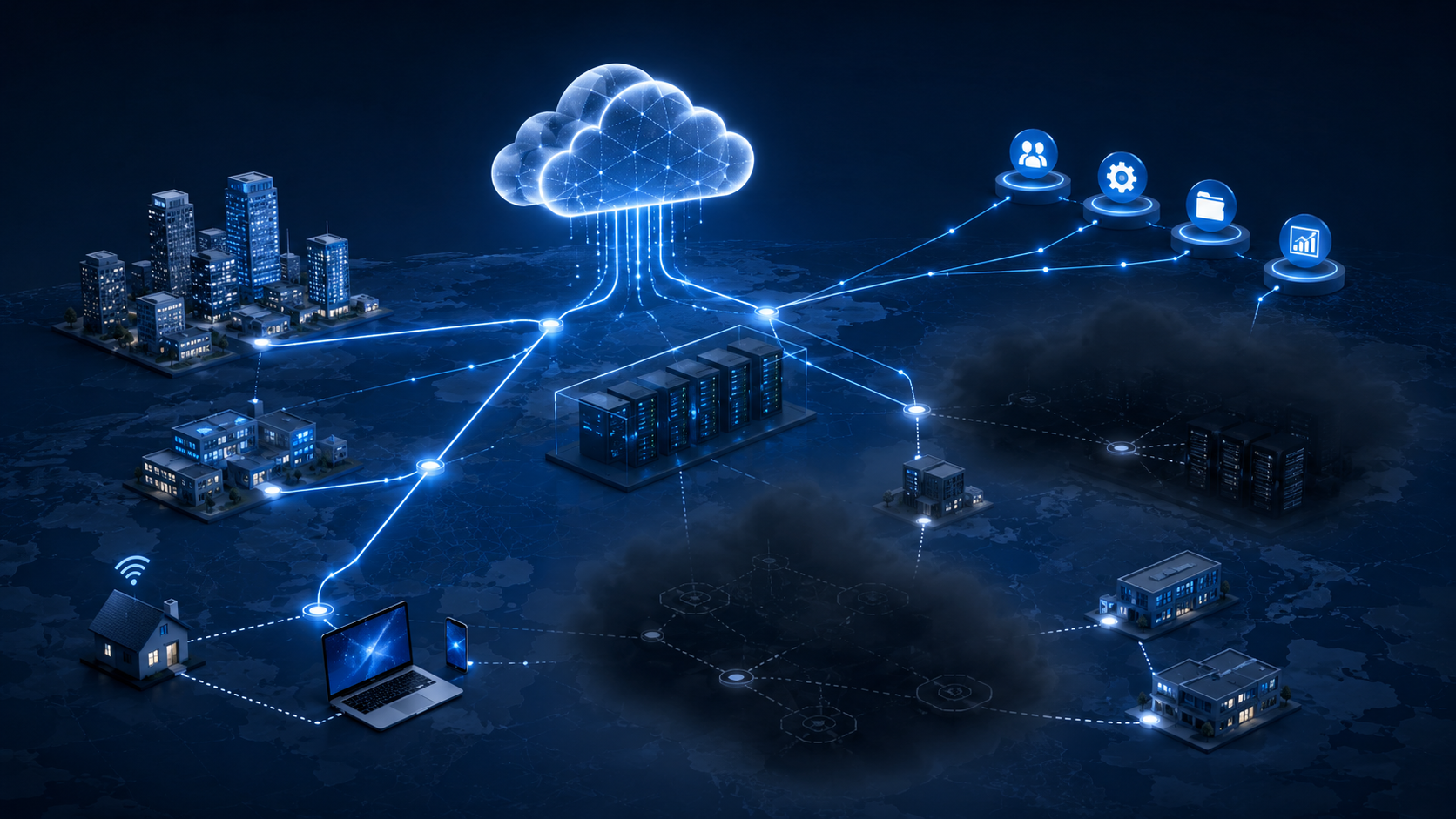

Building a Future-Ready Network Strategy: What IT Leaders Need to Know

Justine Francisco
The Problem Has Changed. Has Your Network Strategy?
For years, legacy network infrastructure has struggled to keep pace with cloud adoption, distributed teams, and hybrid environments. That challenge hasn't gone away it's accelerating. The arrival of AI workloads has fundamentally changed what enterprise networks must do.
AI-driven applications introduce asymmetric traffic patterns, real-time performance requirements, and unprecedented scale which are demands that traditional network architectures weren't built to handle. At the same time, nearly every organization runs a cloud strategy today, yet fewer than half say their network can actually handle the demands of AI workloads. The gap between cloud ambition and network reality is widening, and it's becoming a competitive liability.
Organizations still operating on static, fragmented architectures are already feeling the strain: slow deployments, rising operational costs, blind spots across environments, and growing complexity that consumes IT capacity better spent on innovation.
What "Future-Ready" Actually Means in 2026
A future-ready network isn't just cloud-native. It's AI-ready, observable, and operationally simple at scale.
AI-Ready Infrastructure. AI workloads don't behave like traditional enterprise traffic. Inference workloads require strong wide-area and multi-site connectivity, while training workloads demand dense local networks and both can shift as models, data sources, and endpoints evolve. A future-ready network must adapt dynamically, not require manual reconfiguration every time a workload changes.
True Multi-cloud and Not Just Multiple Clouds. Most organizations have cloud environments on AWS, Azure, and GCP. Far fewer have a connected multicloud strategy. 57% of organizations keep their applications siloed on different clouds, which limits mobility and defeats the core value of multicloud: deploying the right workload in the right environment at the right time. A future-ready network fabric spans clouds uniformly, enabling workload mobility, consistent policy enforcement, and unified management.
Observability as a Foundation. In 2026, enterprises are prioritizing advanced network observability and analytics as foundational capabilities to gain real-time insights into increasingly complex, distributed networks. With hybrid and multi-cloud environments now the norm, experience is becoming the primary metric and infrastructure provides the diagnostic context. Organizations need end-to-end visibility that correlates performance across cloud, on-premises, and edge environments in real time.
Integrated Security that is Built In, Not Bolted On. Security must be embedded into the network architecture, with consistent policy enforcement across every environment. Cloud-native enforcement, rapid deployment, and real-time threat response are becoming baseline expectations rather than advanced capabilities. The goal is a unified control plane where connectivity and security are managed through a single logical framework, not a collection of point tools requiring constant reconciliation.
The Core Pillars IT Leaders Should Focus On
1. AI-Optimized Connectivity Design for the traffic reality of AI, which possesses high-bandwidth, low-latency, and directionally asymmetric. Networks that treat every location (cloud, on-premises, edge) as equally capable, and adjust dynamically as workloads shift, will outperform those built around legacy hub-and-spoke models.
2. Unified Multi-Cloud Fabric move beyond managing each cloud independently. A platform-based approach that provides a consistent operational layer across AWS, Azure, GCP, and on-premises eliminates the complexity that slows deployments and creates security gaps. Agility, not hierarchy, becomes the defining requirement.
3. End-to-End Observability. Enterprise environments now generate more telemetry than human teams can realistically manage. IT leaders are consolidating observability platforms and applying AIOps to reduce alert noise, accelerate root-cause analysis, and automate remediation with labor savings increasingly outweighing the cost of AIOps tooling for mid-to-large enterprises.
4. Operational Simplicity. Speed and simplicity are inseparable. Deploying new connectivity, spinning up security policies, or onboarding a new cloud region should take hours, not weeks. Platforms that eliminate manual configuration and provide centralized control free IT teams to focus on business outcomes, not infrastructure management.
What IT Leaders Should Do Next
Start by honestly assessing whether your current network was built for today's reality or for the cloud environment of five years ago. Key questions:
- Can your network handle AI inference traffic without performance degradation or manual tuning?
- Do you have real-time visibility across cloud, on-premises, and edge or are you managing multiple monitoring tools with overlapping blind spots?
- Are your applications truly integrated across clouds, or are they siloed on separate platforms that limit workload mobility?
- How long does it take to deploy new connectivity or expand into a new region?
Organizations that can answer these questions with confidence are in a strong position. Those that can't should treat network modernization as a near-term priority, not a long-term roadmap item.
Organizations expecting to advance AI adoption in their IT operations largely haven't, and in many cases, the network is the bottleneck. The businesses that close that gap in 2026 will move faster, operate more efficiently, and carry less risk than those that wait.
Future-ready networking isn't a destination. It's the operational foundation everything else is built on.